In this article
- Key takeaways
- What makes a perfect Google ad right now?
- Parts 1 to 3: the search, your name and your reason
- Part 4: say who the ad is for
- Parts 5 and 6: guardrails on AI copy, and your reviews
- Parts 7 to 9: photos, sitelinks and your whole site
- Part 10: send customers back, not form fills
- Frequently asked questions
Key takeaways
- Google now writes more of your ad than you do, so your inputs matter more: your site, your reviews, your guidelines and your conversion data.
- Say who the ad is for. The ad’s job is the right click, not every click.
- If you’re on AI Max, set text guidelines and pin what matters.
- Send booked and paid leads back from your CRM, so bidding learns what a customer actually looks like.
What makes a perfect Google ad right now?
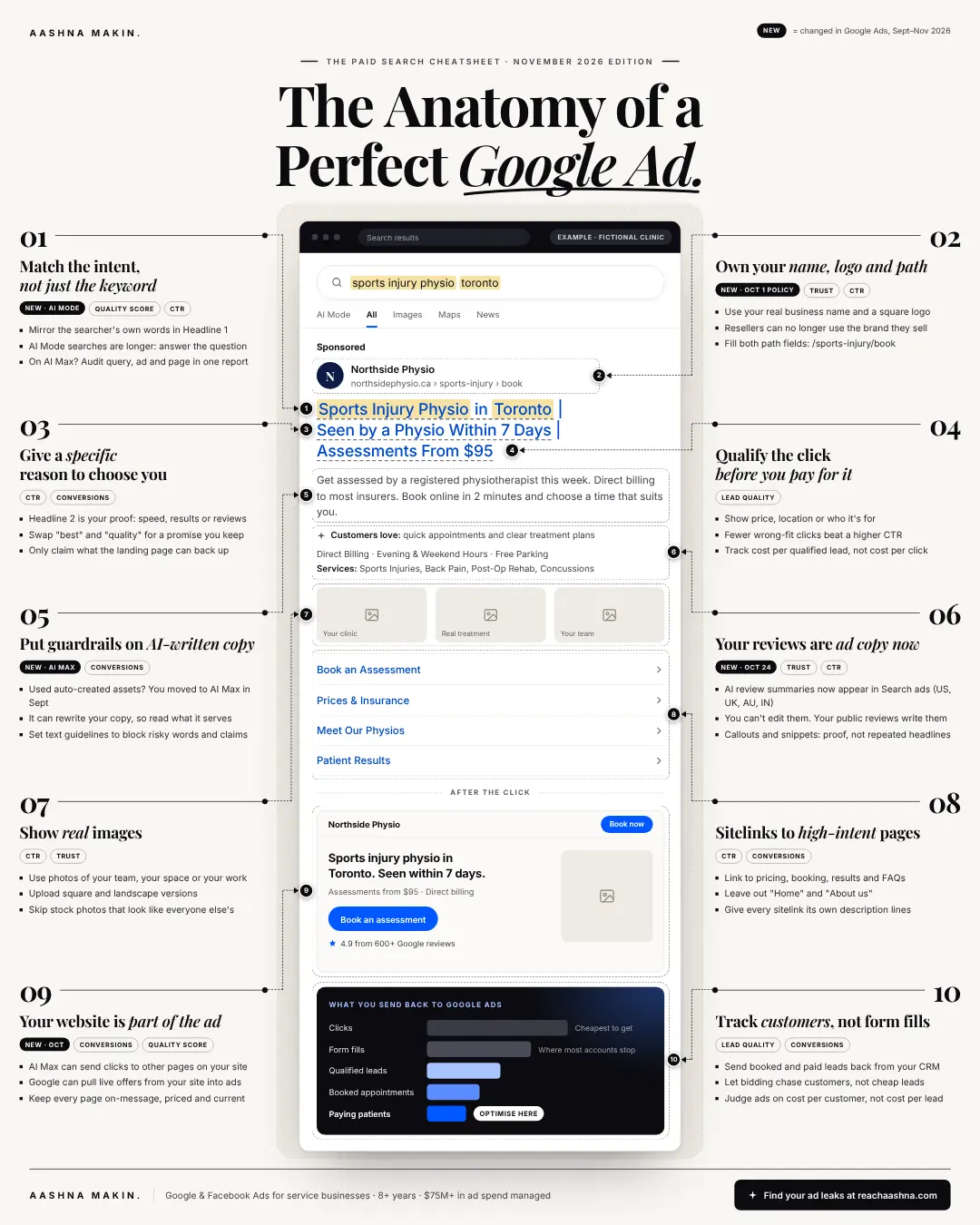
A perfect Google ad right now does 10 things. It matches the search, shows your real name, gives one specific reason to pick you, says who it’s for, keeps guardrails on AI-written copy, treats reviews as ad copy, uses real photos, points sitelinks at pages that convert, sits on a site that is current, and sends real customers back to Google.
I rebuilt my Google Ads checklist for November, and half of it changed since September. I’ll be honest, I’m a very control freak woman when it comes to ad copy. And Google now writes more of your ad than you do. AI Max can rewrite your headlines and pick your landing page. Review summaries show up in Search ads, and you cannot edit them.
So this is the anatomy I’m using with clients right now. The cheatsheet above shows it on a sample ad for a fictional physio clinic, not a client.
Parts 1 to 3: the search, your name and your reason
1. Match the intent, not just the keyword. Put the searcher’s own words in Headline 1. In the fictional example, someone searches “sports injury physio toronto” and the first headline reads “Sports Injury Physio in Toronto”. AI Mode searches are longer, so answer the actual question.
2. Own your name, logo and path. Since October 1, resellers cannot use the brand they sell as their business name. Use your real business name, a square logo, and fill both path fields.
3. Give one specific reason to pick you. How fast, how much, how well rated. Headline 2 is your proof, so in the example it reads “Seen by a Physio Within 7 Days”. “Best” and “quality” are not reasons. Swap them for a promise you keep, and only claim what the landing page can back up.
Part 4: say who the ad is for
4. Say who it’s for. I once had team-building ads pulling in school trips and group events. The clicks were coming, but they weren’t the buyers we actually wanted. So we added “built for corporate teams” to the ad, and it spoke to the right people.
This is something I tell my clients: the ad’s job is the right click, not every click. Show the price, the location or who it’s for, so you qualify the click before you pay for it. Fewer wrong-fit clicks beat a higher click-through rate.
Parts 5 and 6: guardrails on AI copy, and your reviews
5. Put guardrails on AI-written copy. If you used auto-created assets, you were moved to AI Max in September. It can rewrite your copy, so read what it serves. Set text guidelines to block risky words and claims, and pin what matters.
At the luxury travel brand I worked at, “luxury” stayed pinned no matter what Google recommended. That word means a different price point to everyone, and I am not comfortable giving control to Google on it. I even pin my descriptions, forget about headlines.
6. Treat reviews as ad copy. AI review summaries now run in Search ads in the US, UK, Australia and India. You cannot edit them. Your public reviews write them.
Parts 7 to 9: photos, sitelinks and your whole site
7. Use real photos. Your team, your space, your work. Upload square and landscape versions, and skip the stock photos that look like everyone else’s.
8. Point sitelinks at pages that convert. Pricing, booking, results, FAQs. Not Home and About.
9. Treat your whole site as part of the ad. AI Max can send clicks to other pages on your site, and Google can pull offers from your site into your ads. So every page needs a current price and a clear next step. If a page is out of date, I think it’s now an ad problem, for sure.
Part 10: send customers back, not form fills
10. Send customers back, not form fills. Clicks are the cheapest thing to get, and form fills are where most accounts stop. Import booked and paid leads from your CRM, so bidding learns what a customer actually looks like. Let bidding chase customers, not cheap leads, and judge your ads on cost per customer, not cost per lead.
AI is great for a lot of this. But do not blindly follow it. The more Google writes for you, the more your inputs matter: your site, your reviews, your guidelines, your conversion data. I always act as if the ad spend is going from my own bank account, and I want the last say on every one of those inputs.
Save this for your next account review.
Take ownership.
Frequently asked questions
What changed in Google Ads this autumn?
Three things on my checklist. If you used auto-created assets, you were moved to AI Max in September. Since October 1, resellers cannot use the brand they sell as their business name. And AI review summaries now run in Search ads in the US, UK, Australia and India.
Should I pin headlines if Google recommends unpinning them?
Pin what matters. At the luxury travel brand I worked at, “luxury” stayed pinned no matter what Google recommended. I even pin my descriptions. Set text guidelines for the rest and read what gets served.
Can I edit the AI review summaries in my Search ads?
No, you cannot edit them. Your public reviews write them. That’s why I treat reviews as ad copy.